Wednesday, October 2, 2024

ORKNEY ISLANDS, SCOTLAND: NEOLITHIC SITES, SWANS, GRAY SEALS, AND BLUE SKIES!

Regal Princess/Orkney Islands, Scotland
Wednesday, October 2, 2024
Sunny, 56F

Janie at the Standing Stones of Stennis
No Outlander type travel to 
Scotland of long ago!

Orkney is an archipelago off the north coast of Scotland. There are about 70 islands, of which 20 are inhabited (population 22,000). The largest island, the Mainland (where we docked), has an area of 202 sq miles, making it the sixth largest Scottish island and the tenth largest island in the British Isles. Orkney's largest settlement, and its administrative center, is Kirkwall, where the Regal Princess docked today.

 The islands have been inhabited for at least 8,500 years, originally occupied by Mesolithic and Neolithic tribes and then by the Picts. Orkney was colonized and later annexed by the Kingdom of Norway in 875 A.D. and settled by the Norsemen.

In 1472, the Parliament of Scotland absorbed the Earldom of Orkney into the Kingdom of Scotland, following failure to pay a dowry promised to James III of Scotland by the family of his bride, Margaret of Denmark.

Residents are called Orcadians; they speak a distinctive dialect of the Scots language and have a rich body of folklore. Orkney contains some of the oldest and best-preserved Neolithic sites in Europe; the "Heart of Neolithic Orkney" is a designated UNESCO World Heritage Site. [Note: It is probably the only UNESCO World Heritage site where sheep roam free]

This morning, we met our new friends for our private tour today, Barb (who arranged the tour) and Bob [Michigan], Stacy and George [California].  The six of us met Paul of PJ Orkney Tours ( www.jporkney.co.uk) right off the ship on this absolutely perfect day—sunny, no wind, and tolerable temperature.

Paul of PJ Orkney Tours

Paul drove a Mercedes Benz electric van which was very comfortable and quiet. The first thing he mentioned was that the Orkney Islands, Juneau, Alaska, St. Petersburg, Russia, and southern Greenland all share the same latitude. Also, the Orkney Islands are closer to Norway than London!  Interesting facts! But, Paul was full of interesting facts as we drove along.  We were very intrigued by this area of Scotland.

Beefy beef cattle along the way

Sheep grazing along the way

According to Tour Guide Paul, the weather is mild with the average 60F in the summer and 40F in the winter. Snow is not common and does not stay. The Gulf Stream makes the difference.  Wind is another story and makes life chilling with gale force winds (30 mph) every 13 days in the winter.  Another fact: in the summer the population experience almost 24 hours of sunlight, and in the winter, mostly dark. He said owls are seen in the daylight in summer, what choice to they have if they want to eat?

There are few trees since the Neolithic people used existing trees for building materials and keeping warm and now the winter wind makes it difficult to grow trees.  Ninety-five per cent of the land is grass and the area is known for its highly prized beef cattle, dairy cows for cheese, and sheep. As we passed by on winding narrow roads, we saw plenty of big beefy cattle and sheep.  The stone fences dividing the properties and keeping the livestock penned can be up to 200 years old or more.

After a look at the seals swimming freely in the loch nearby, our first stop was the Standing Stones of Stenness, which are older than those at Stonehenge. Nearby was the Ring of Brodgar. I am totally intrigued by these “standing stones,” and of course, the TV series Outlander has made the sites even more popular. No one knows for certain what the sites mean, but speculation is that they were part of ceremonies and very sacred.  The Standing Stones of Stenness are 17 ft out of the ground with 5-6 ft underground. Many are still standing despite the impact of weather.

One of the Standing Stones of Stenness
there are about 12 still visible
forming a sort of circle

Standing Stones of Stenness

Standing Stones of Stenness

Paul told us that archeologists from around the world have studied the sites, with enough artifacts (over 100,000) for further research for the next 10 years.   We visited the Ring of Brodgar too, with 60-70 stones.

Ring of Brodgar
One side, part of the circle

Ring of Brodgar
The other side, overlooking a loch


The ripples on this rock are fossilized wave action

How do the Orkneys fit into WWI and WWII? The British and American Navy, Army, and Air Force used the area as a base—I will be studying this in the future. In WWII, one of the reasons was because Nazi Germany occupied nearby Norway.

Another important stop was Skaill House, a historic manor house first built in the early 1600s and is still a residence by a Lord today. The manor house overlooks Skara Brae, western Europe’s best example of a neolithic village.   We enjoyed lunch at the gift shop’s coffee shop—TK and I shared carrot cake. Daring Bob tried Cullen Skink, a soup of smoked fish, leeks, potatoes, and milk. He said it was good, even though he really wanted Steak Kidney Pie.


One of the homes in Skara Brae--
a fire would be in the center

I cannot edit the photos because of the glitch since the beginning of this trip.
I would like to lighten it up so you can see the beds

It was an overwhelming experience to glimpse into the way people lived over 5000 years ago. The village was discovered about 1850 when it was uncovered by a storm, and predates the Egyptian pyramids. Two hundred people could have lived here in the interconnected homes, partly underground, ten to a home, according to Paul. 

Dear Reader, I had no idea what the Orkney Islands were all about, as well as its prehistory—we are learning so much new information and this short blog will not do it justice. I know I will research further. I have been watching YouTube videos about archeological discoveries in England, and now I need to dig further! Enjoy the photos!

Paul stopped at his home so we could meet his delightful wife Jane—their home is in The Palace, a small village. A castle ruin is right in front of their home, and an old church and very old cemetery is right next door. Jane is a teacher, 11-18 year olds, and they have a small shop with most products made by them.  https://www.jporkneyproduce.co.uk/ 

Paul and Jane's home in village called The Palace
The Palace, for which the village is named I believe,
 in ruins, directly across from Paul's house

The church next to Paul's house

The extent of the village of The Palace

Clear lochs, sun, fresh water, brackish water, ocean water, swans, gray seals, blue skies, beautiful clouds, beefy beef cattle, hundreds of sheep, stone fences, and neolithic sites---Orkney Islands was a great stop!!  We could not have asked for a better tour guide or a better tour!

TK's Takes:  This has been the best day so far. Weather and a private tour. Private tours are riskier in a sense, but they are more personal. You are not jam packed in a big bus and you can go to places that larger buses cannot go.  Most of the time private tours are less expensive than cruise tours.  He saw two seals in the first loch.  They swam into that area because the orcas that were after them could not get them there--a land bridge prevented that.

TK is always drawn to the sea...


Tuesday, October 1, 2024

SUNSET OVER THE IRISH SEA!

Regal Princess/The Irish Sea
Tuesday, October 1, 2024
Sunny, 56F

Sunset over the Irish Sea tonight

This was a quiet day at sea, and I won’t be blogging as much on sea days, but there were a couple things to note, most said in photos!


Rocks in the Irish Sea--noon October 1, 2024


Unbaked calzone
in a cooking demo
Credit to TK

Artful seafood
Credit to TK

I really wanted this photo taken!
Credit TK


Pool Deck / October 1, 2024
Credit TK

TK's Takes: As cold as it was, with just a little sun today, some people headed to the Pool Deck lounge chairs. He has even seen people in the hot tubs by the pool.


Monday, September 30, 2024

THE BONNIE BONNIE BANKS O' LOCH LOMON'!

Regal Princess/Greenock, Scotland
Monday, September 30, 2024
Cloudy, foggy, rainy, 50F

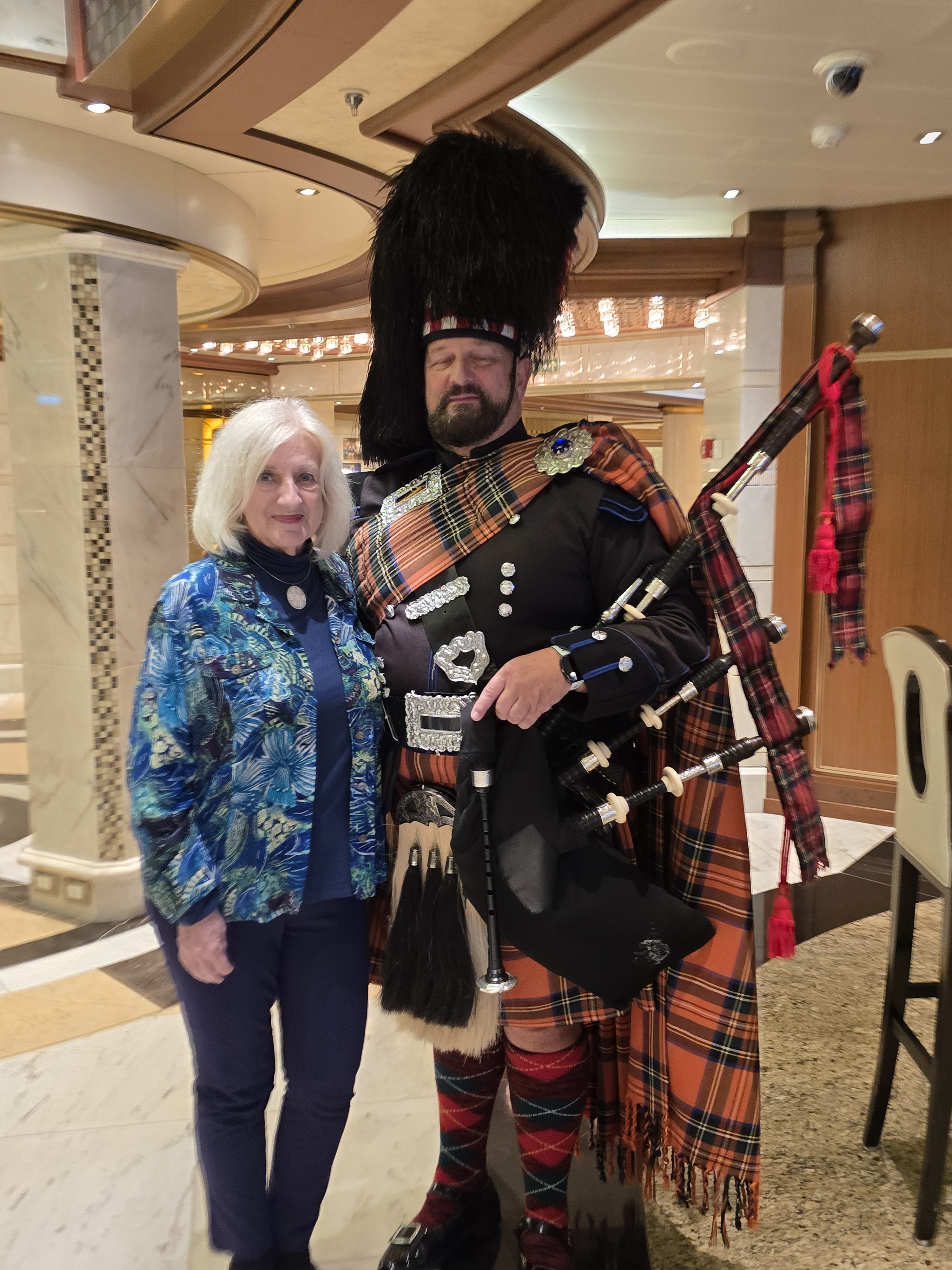
Pipe Major David McRobert
played bagpipes before dinner

Greenock, where we are docked today on the River Clyde, is a small town in the far west of Scotland. Its population is around 44,000, and its most famous resident was James Watts who invented the steam engine around 1776.  Today it is a commuter town for Glasgow which is 25 miles away.

We were scheduled on a scenic bus tour around a few “lochs.”  Today was colder than the previous many days, and even wearing a t-shirt, a turtleneck, a sweatshirt, a jacket, and a rain jacket, I was very cold.  I am looking at this trip around Great Britain as a prep for winter back home.  TK is cold too, so it isn’t just me!  Believe it or not, there were people on the bus who wanted the air on. 

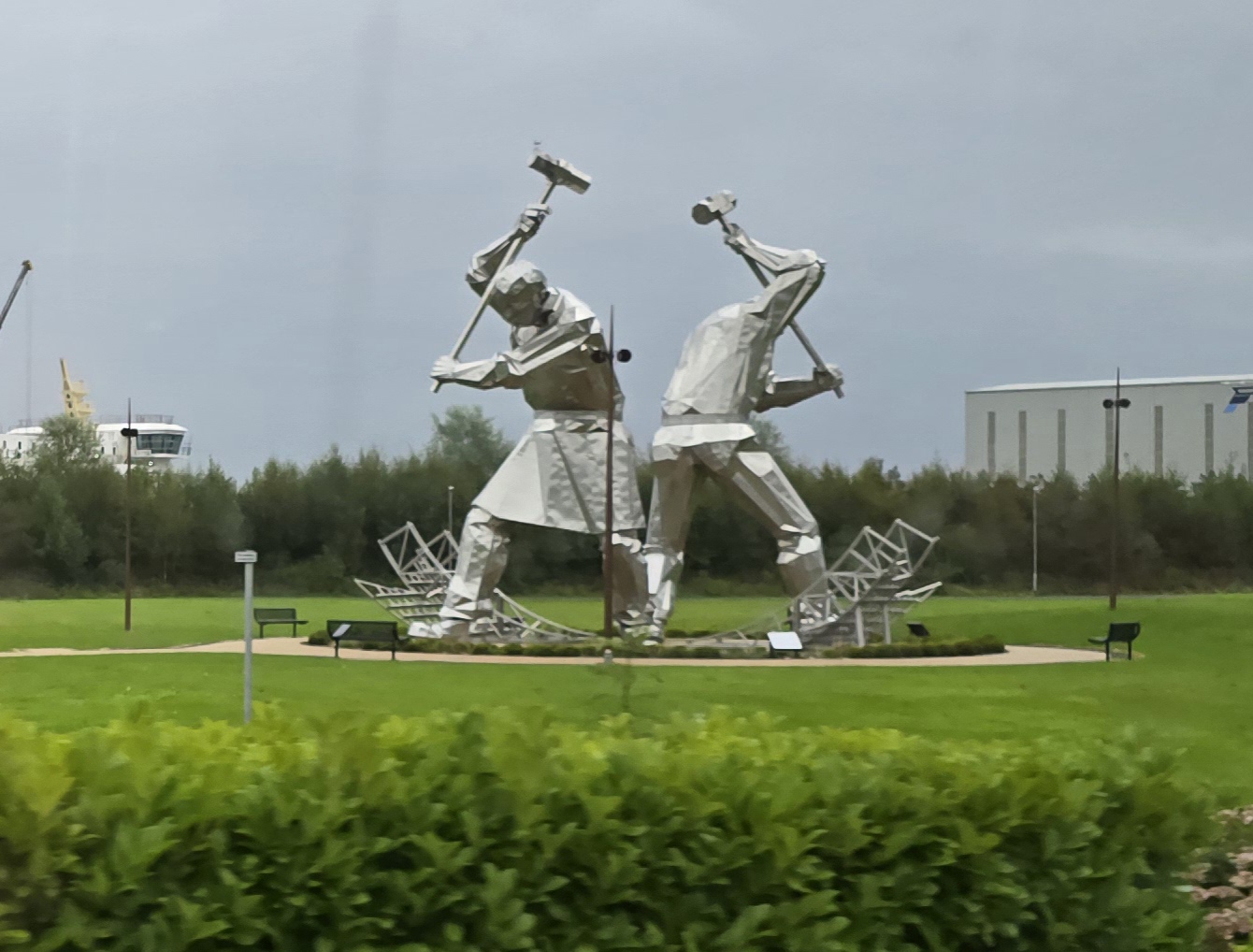
Public art near Greenock
nothing like throwing sledgehammers

Our tour guide was a delightful Scottish lad named Scott. He told us that if the Scots look at the River Clyde and can’t see across, it is raining. If they can see across the river, it isn’t raining yet.  I thought that was quite a funny remark.

Scotland’s population is 5.5 million with 8 million sheep! Only about 60,000 people speak Scottish Gaelic today, and English is the main language.  Scott gave us a little history lesson, and most interesting was that the Romans called the area Caledonia from the first century.

The countryside is very hilly with lots of deciduous looking trees, although still completely green, along with lots of pine trees.  We saw many grazing sheep along the way, but did not get any photos of sheep! Houses made of stone, brick apartment buildings, stone fences, ferns, creeks and rivulets, the area is hillier that Pennsylvania, although the countryside did remind me of Bear Lake in Warren County, untouched beauty (that is until the gas drilling started).


Loch Lomond

Our first stop was Loch Lomond, Scotland’s second largest freshwater lake that is 62 4 feet deep with a surface area of about 27 square miles, in the midst of
   Trossachs National Park.  We did see some hardy fishermen, most likely fishing for perch, brown trout, bream, eel, or flounder.  A few sailboats were on the lake too.

 Within about 5 minutes walking distance was the charming village of Luss. We stopped for a coffee and freshly baked scones before it was time to board the bus. 

Some homes in the village of Luss, Scotland

Coach House Coffee Shop


The luscious baked goods, charming coffee shop


Coffee, scone, strawberry jam, butter, and clotted cream!

Scott played the song, Bonnie Bonnie Banks o’ Lomon’, for us.   You have probably heard this lovely song, with the second verse lyrics. Please take the time to Google this song!
https://www.youtube.com/watch?v=gb8AGuD2uOI) :   

O ye'll take the high road and I'll take the low
And I'll be in Scotland afore ye
For me and my true love will never meet again
On the bonnie, bonnie banks o' Loch Lomon'

Hearing a song like this right on the banks of Loch Lomond really moved all of us. I thought of my little knowledge of Scottish history and their conflicts over the years, and the Scottish troops in World War One with their kilts and bagpipes—very moving to be right here.


Other lochs we saw while on the bus were Loch Long, Loch Fyne, Loch Eck, and Holy Loch. We  reached a ferry boat that took us across the River Clyde back to Greenock (the ferry crossing for our bus was $134).  Along the route of highland glens and valleys, there was extensive road work because of rockslides—Scott told us that just last week a rockslide had prevented passage where we were riding. Well, I am glad that was last week. 

Argyll National Forest Park

National Forest

Another view

Rock for my brother
Scotland is not a volcanic island, but it had many
volcanoes millions of years ago

Volcanic activity occurred across Scotland as a result of the collision of the tectonic plates, with volcanoes in southern Scotland, and magma chambers in the north, which today form the granite mountains such as the Cairngorms.
Equipment to repair the damage of the rockslide

Scott told us that Scotland gets from 3-4 ft of snow and the low temperature is around 8F. There are only 3 public outdoor swimming pools in Scotland—that should give you an idea about the climate. However, we passed one of those public swimming pools and at least 20 people were swimming in it! Scott said it was heated—ha!

Woodcarver advertising his wares along the road

Our scenic ride was over and back to our warm stateroom to get ready for dinner!  I can tell I have Scottish DNA, but the tolerance for cold is no longer there!

TK’s Takes:  He saw Mallard ducks and magpies. He said there was more room on the trains in Germany than on our bus.  He also remarked there are no solar panels here!

Loch Ness is 116 miles away.  Scott did tell us about the Kelpies--  Kelpies are often described as grey or white horses with dripping manes. When they appear as humans, they are usually men with seaweed in their hair or hooves instead of hands.   They lure humans into the water to drown them. We did not see any Kelpies, thank goodness.


Sunday, September 29, 2024

CRUISING THE MERSEY WITH THE BEATLES!

Regal Princess/Liverpool, England
Sunday, September 29, 2024
Partly sunny, 58F, windy

Liverpool skyline this morning-on the Mersey

Liverpool is a port city and borough of Merseyside, England with a population of approximately 496,770 in 2022. The city is located on the eastern side of the Mersey Estuary, adjacent to the Irish Sea, and is approximately 178 miles from London. Liverpool is the fifth largest city in the United Kingdom.


I love Liverpool!  We walked off the ship onto the waterfront and the city was right there. 

Near the ship


Two of these distinct sculptures sit atop the building


Toy shop


TK takes a photo of Dunkin'
Actually our preferred coffee

The Cavern
The Beatles played at the Cavern Club--there are 
three similarly named spots nearby

After a coffee and a mug purchase at Starbucks, it was an easy walk to the Beatles Museum on Mathews Street where we spent about an hour and a half. TK is not as big a fan as I, but he knew more about them than I did. 


The Liverpool Beatles Museum

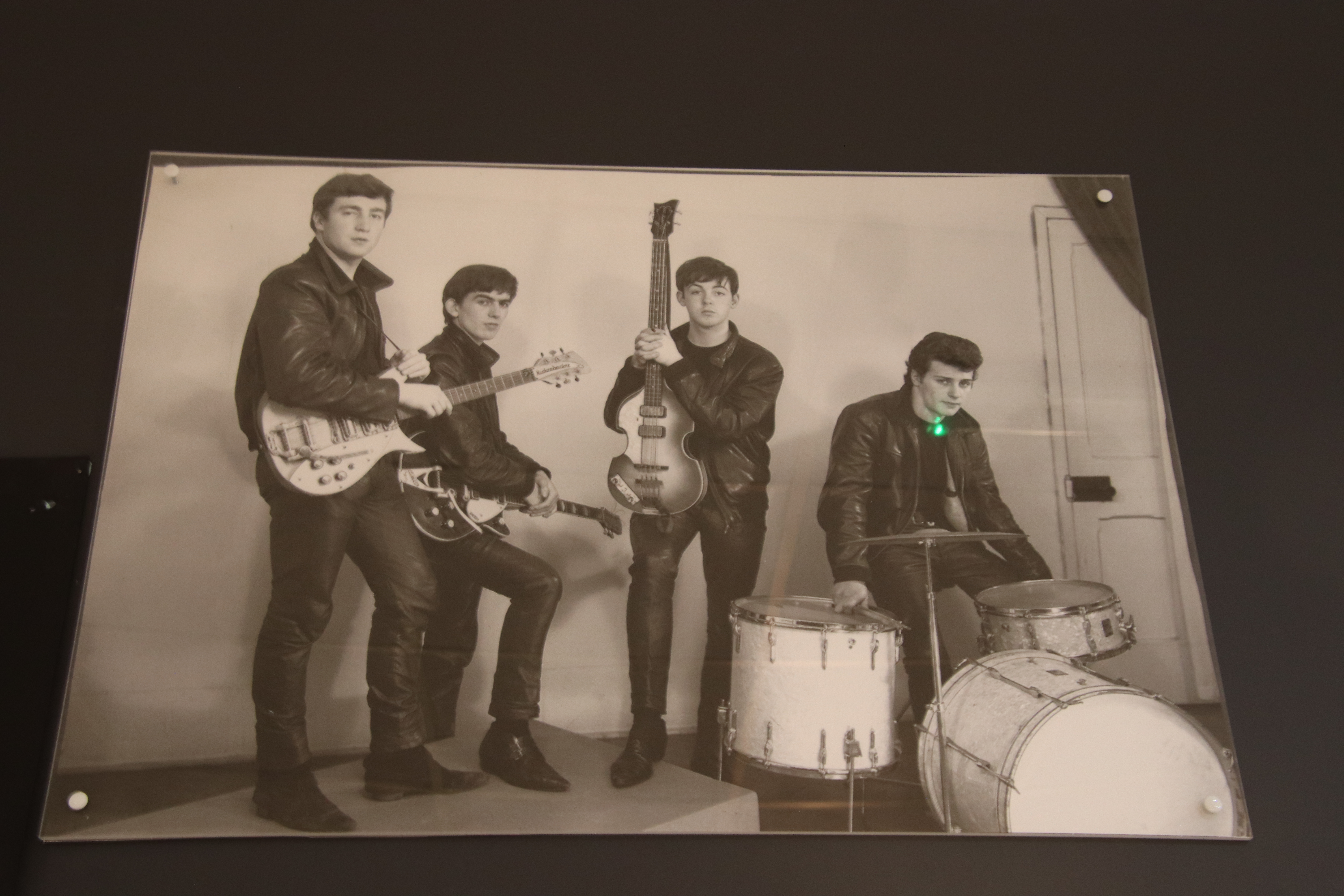
There were three floors of memorabilia—albums, written notes, Pete Best’s drum set, clothing.  Three floors covered the 3 eras of the Beatles, 1959-1962, 1963-1966, and the last era, 1967-1970.  My favorite albums, the ones I purchased years ago, were Help!, Rubber Soul, Meet the Beatles, A Hard Day’s Night, and Revolution. My favorite song was always “Yesterday,” but I love most of the early and middle era songs.  TK said he purchased several albums back in the day, including The White Album. His favorite songs were “Back in the USSR” and “It’s Your Birthday.”  Of course Beatles music was playing throughout the museum.

John, George, Paul, and Pete Best


Pictured for Friend M--she will know why

Brother Bill brought lederhosen exactly
like this back from Germany when he
was in the US Army for
Randy and Brian
John Lennon gave a pair to his son.


Liverpool is easy to walk, and a gigantic shopping area is so close. We spotted a shop called Hotel Chocolat and went inside this for another coffee. A sweet clerk gave us each a triple cherry chocolate to eat, almost heaven! If only we could safely bring chocolate home!!

Triple cherry chocolate

We really wanted a British lunch, so we stopped at The Old Bank, originally a beautiful, ornate bank. We enjoyed Sunday roast (TK) and Scouse (Janie). What is scouse? A sort of beef stew with potatoes, carrots, and small chunks of beef—just like my mother made—my roots!! Sunday roast was beef, with potato, stuffing, Yorkshire pudding. Why on earth they call Yorkshire pudding a pudding I have no idea—it is really a flaky kind of bread to me, made of eggs, flour, milk, and water.  TK also had sticky toffee for dessert (a kind of sponge cake drizzled in chocolate, with a bit of vanilla ice cream.) 

Inside The Old Bank

Sunday Roast
The Yorkshire pudding looks like a baseball glove
The ball on top is the stuffing
Cheesy cauliflower, broccoli, potatoes, and beef

Scouse

It was time for us to walk back to the ship. We wanted to catch the famous Beatles statue—early this morning there was no crowd, but this afternoon the city was full of people.  Everything seems to be open on Sundays in England.

I loved this little street cleaner

Beatles statue on the Waterfront

Tonight for dinner TK had beef stroganoff to see how the current chef made it—I will try to find previous versions on other cruises which were quite humorous.  I had fish and chips, which were quite tasty.

TK’s Takes:  He thought Liverpool was a suburb of London.  He liked how clean and modern it was, mixed with older architecture.  

Note: Liverpool suffered the second highest number of civilian deaths in air raids in the country in World War II.  Nearly one third of the houses in Liverpool were damaged or destroyed.  Between 1940 and 1941 almost 2300 people were killed in Liverpool.

And another note: It’s going to be a boy!!  In January I am going to be a great aunt for the 3rd time!!